Pricefx
AI you can use, trust and audit. Live from Accelerate 2026, October 13 to 15
This week, pricing leaders from manufacturing and distribution are gathering in Denver to talk about what AI is really doing for pricing, and what it takes to capture the value. Our team is in every room, sharing the moments, ideas and voices that stand out, as they happen.
The big ideas emerging from Accelerate 2026
-
AI in pricing is moving from experimentation to everyday decisions, and leaders now want proof it can be trusted, approved and audited.
- Agents are starting to catch margin risk and recommend action while there is still time to act.
- Speed to value is the new benchmark, with AI helping teams configure and adopt pricing in weeks, not months.
- AI success depends on people and process as much as technology: adoption, governance and shared design.
Big idea of the day
Day two sharpened the same argument from day one into something more operational. If day one was “AI has arrived, the work is now foundation, trust, and people,” day two’s big idea was the next layer down:
The technology is the easy part. The hard, decisive work is adoption, governance, and the unglamorous foundation underneath, and the winners are the ones building for the humans who have to actually use it.
Session recaps & updates
How Calumet embedded pricing discipline as the speed of volatility
Session speakers:
-
Brad Onofrio, Senior Director Sales Operations, Calumet Inc.
What happened: Brad came ready with a plan for a normal year, and then 2026 refused to be normal. He described a market unlike any he had seen, the kind where pigs start flying, and credited Pricefx with keeping Calumet from being dead in the water, changing 70,000 price lines automatically when speed was survival. His philosophy is crawl, walk, run, but the year forced a sprint. What makes the talk land is his honesty about what he would do differently. He leaned too hard into price administration and ignored analytics, and spent too much time on internal mechanics instead of helping sales make better calls. The arc he is proudest of is personal: six months ago AI intimidated him, now he cannot picture a day without it, and he is done with VLOOKUP for good. His parting image stuck, that automation without a next step just means printing auto-generated price letters one at a time.
 Without Pricefx, in 2026, Calumet would have been dead in the water.
- Brad Onofrio, Senior Director Sales Operations, Calumet Inc.
Workshop: Configuring Pricefx faster with the AI toolkit
Session speakers:
-
Arjun Coimbatore Nagarasan, Senior Director Product Activation, Pricefx
-
Sean Missingham, Principal Product Advisor, Pricefx
- Evan Winston, Solution Strategist, Pricefx
What happened: This one put the AI Toolkit to work in real time, and the mental model that stuck was a simple one: treat it like a solution architect sitting next to you. Attendees handed it a business problem with context rather than step-by-step instructions, and watched it configure real outputs, a working dashboard among them, then refine on feedback. The point the team kept coming back to was that this is a thought partner, not a vending machine. It learns how your business works and what you prefer, keeps that as your own IP rather than sharing it, and gets sharper over time. And its reach is wider than configuration alone, running from core workflows like price setting and quoting all the way to building agents.
Think of the AI Toolkit as taking on the role of the solution architect, there for advice and knowledge on how best to implement a specific use case.
- Sean Missingham, Principal Product Advisor, Pricefx
How Southwire turned advanced pricing into faster sales decisions
Session speakers:
-
Jonathan Hendricks, Director Pricing Strategy and Systems, Pricefx
What happened: Jonathan opened with the before picture, and it was a vivid one: the Wild West, 100-plus people able to change customer pricing in SAP, no governance, no way to trace who approved what. Pricefx brought order, moving all price setting into one place with real controls and far better analytics. But the heart of the session was adoption, not controls. John Bloys put the stakes plainly, that the best models in the world are worse than mediocre ones if nobody uses them. So Southwire built for buy-in from the start: sellers in the pilot early, the context behind the model shared openly to earn trust, confidence levels marked high, medium, or low, and complexity revealed progressively instead of all at once. Four weeks into the scaled rollout, Jonathan’s advice was foundational, establish your process and vision first, and treat clean, available data as the thing everything else rests on.
We can have the best models in the world, but if no one's using them, that's arguably worse than having models that aren't as good that everyone uses.
- John Bloys Senior Pricing AI Lead, Pricefx
Behind the scenes
The moments between the sessions.


Big idea of the day
AI in pricing has crossed from promise to production. The factor separating winners from those who are stuck isn’t the technology; it’s the foundation, trust, and people needed to turn it into margin. The organizational work is the hard part, and humans stay at the center of it.
Session recaps and updates
Bold bets: How far AI has taken pricing in a year and what it takes to capture
Session speakers:
-
Ronak Sheth, CEO, Pricefx
-
Carl Knight, VP Pricing, ICP
- Jose Paez, Chief of Staff, Pricefx
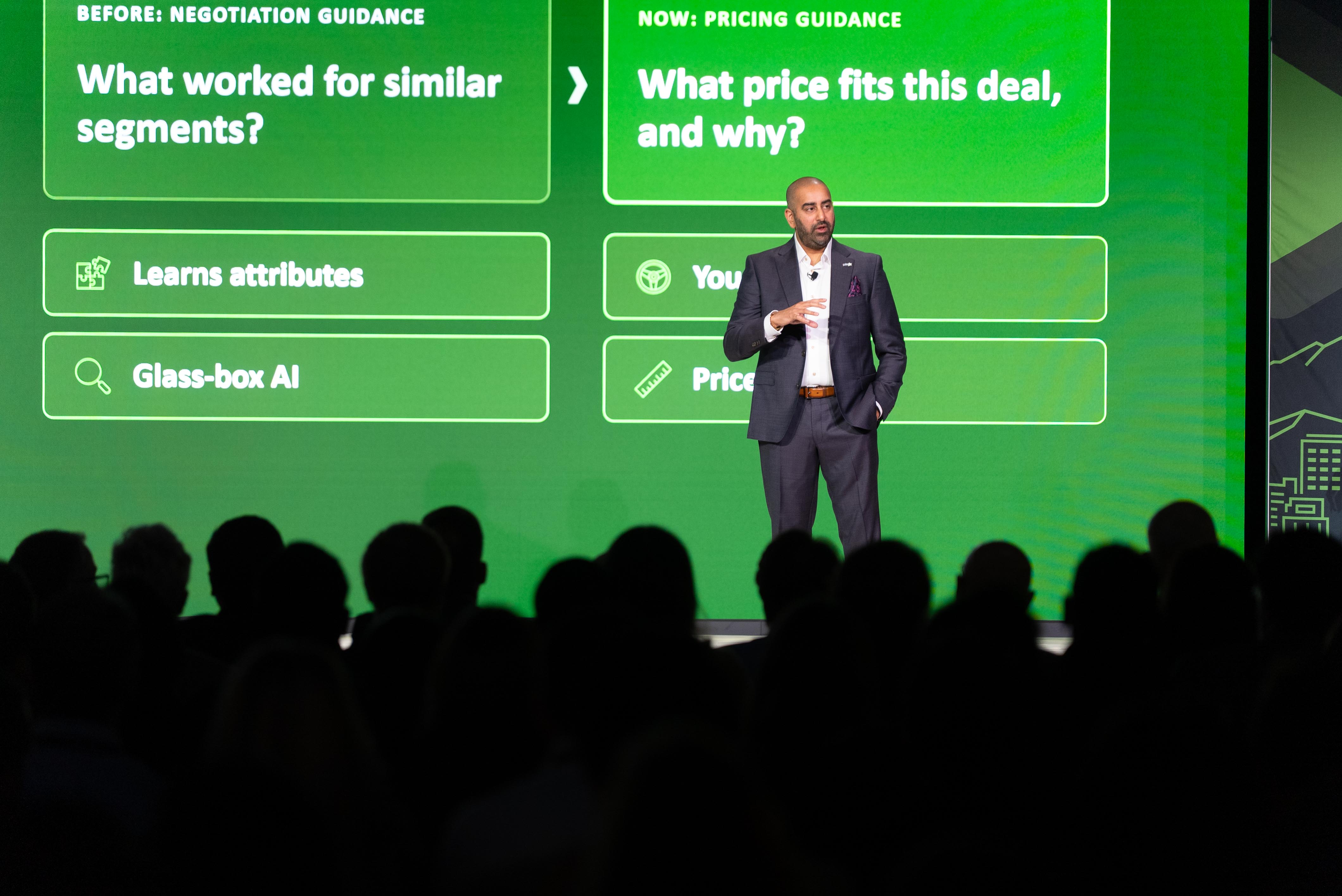
What happened: The opening keynote shows that this year was a report card, and Ronak Sheth did not grade on a curve. He opened Accelerate by holding up the AI commitments Pricefx made a year ago and showing, one by one, what actually shipped: agents now running in production across a growing customer base, AI-assisted configuration, and an open platform that wires enterprise LLMs straight into Pricefx, all on the systems customers already run. The honest moment landed early. Pricefx could have shipped a safe roadmap and called it a good year, he said, and chose the harder road on purpose. From there it got concrete, with Carl Knight of ICP joining for a live Q&A, a leader from Databricks on stage, and Jose Paez running a live demo. The message underneath it all: the technology is ready, and the real work is what you do with it.
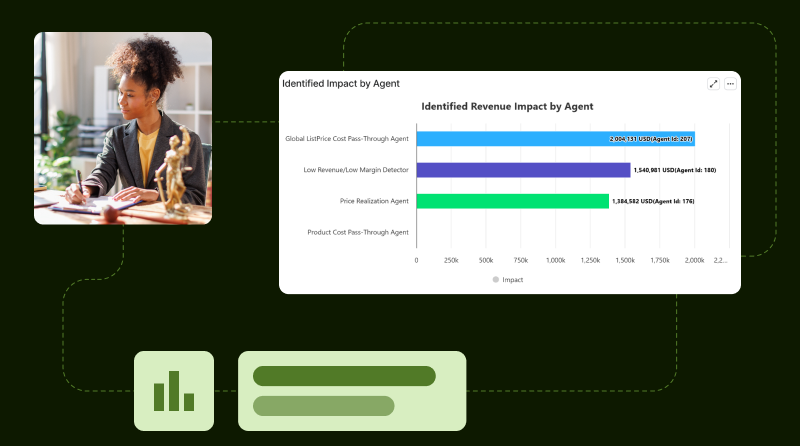
Agents met a need we have. We are resource-constrained and wanted to move past static analytics and dashboards. Agents did the work for us and gave our audience action items.
- Carl Knight, VP Pricing, ICP
What this year asked of pricing leaders
Session speakers:
-
Grace Shafer, Sr. Director of Revenue Management, Iron Mountain
-
Bhadra Menon, Senior Director of Global Strategic Pricing, Cargill
- Nancy Capelli, Senior Director, Software Monetization, NVIDIA
- Kristin Daniels, Vice President, Pricing Strategy, Watsco
- Lindsay Sanchez, Chief Marketing Officer, Pricefx
What happened: This year brought pricing pressure, AI mandates, and no shortage of market turbulence, and it asked a lot of us. Our all-female panel of leaders from Iron Mountain, Cargill, NVIDIA, and Watsco spoke with Lindsay Sanchez, CMO at Pricefx, about it all. Agentic AI came up first and loudest, changing how teams work at a pace few expected. But the stories stayed practical: Cargill on keeping a human at the start and the end across 700-plus pilots, Watsco on work that used to take weeks now done in hours. Through it all, the panel kept coming back to the basics, focus, and knowing where to spend your energy.
Lean into who you are, and you can take that into leadership.
- Nancy Capelli, Senior Director, Software Monetization, NVIDIA
How PHINIA turned agents into always-on margin defense
Session speakers:
-
Adam Dawson, Business Development Director, PHINIA
-
Hailey Long, Director of Category Management, PHINIA
What happened: PHINIA came to talk about margin defense and ended up telling a better story: where the margin was actually hiding. Hailey Long and Adam Dawson walked through their agent rollout with real candor, starting with a rule that kept everyone honest, a 2x ROI benchmark, because a million metrics exist but everyone understands ROI. Getting there took work: data to clean, early results that looked too good to be true, and the lesson that agents are only as sharp as the data behind them. They stayed disciplined too, since more agents is not better and nobody needed another inbox of alerts. The payoff landed somewhere no one expected, and that surprise became the point. They did it with zero added headcount, which is what makes going global feel within reach.
We hit our 2x ROI objective, but in unexpected places. Not the top accounts, which surprised us, but customers who were not on our radar, legacy discounts and rebates, a lot of small bleeders.
- Adam Dawson, Business Development Director, PHINIA
Beyond the AI hype, pairing pricing talent with agile AI
Session speakers:
-
Grace Shafer, Sr. Director of Revenue Management, Iron Mountain
What happened: Grace kept her focus on what is actually possible with AI, and framed getting there as an adventure in the Tolkien sense, the uncomfortable kind that makes you late for dinner. Her advice, be the Gandalf or have a Gandalf, set the tone for a talk that was equal parts optimistic and clear-eyed. She was candid about the discipline it takes: a new head of AI who says no to the projects that only look like a fit, a hard look at tooling so twenty tools don’t end up doing the same job, and research showing AI can intensify work rather than lighten it, so you have to guard your team’s load. Her throughline was reassuring and demanding at once. People matter more than ever, the old “trust but verify” becomes “trust and verify,” and the real work is going on the journey rather than pretending you can skip it.
With AI, people remain your most important asset. In fact, more than ever.
- Grace Shafer, Senior Director of Revenue Management, Iron Mountain
Building the commercial brain with pricing at the center
Session speakers:
-
Jason Robert, Managing Director, PwC
What happened: Jason Robert opened with a racetrack. In 1990 a championship pit stop took eight seconds, today it takes about two, and the reason is simple: competition forced the innovation. He used that to reframe the whole commercial org. Sales are the driver, pricing is the crew chief, and a crew chief who also has to change the tires breaks the pit stop, the same way a pricer buried in data wrangling never gets to strategy. His challenge to the room was blunt, you are not thinking big enough, because the windows of opportunity keep shrinking and a sixty-day analysis lands long after the buying moment has passed. The next evolution, he argued, is a commercial brain with pricing at the center and Pricefx as the engine. The panel that followed made it practical, showing how agents let teams fail fast, fund the foundation with quick wins, and stop pretending phase two will ever come if everything gets crammed into phase one.
Sales are the driver. Pricing is the crew chief.
- Jason Robert, Managing Director, PwC
How Milliken is building an agent-ready foundation
Session speakers:
-
Stephanie Kyle,Pricing Director, Milliken & Company
What happened: Stephanie’s message was deceptively simple: you can’t agentify work you can’t see. Before AI can help with pricing, pricing has to exist as a real digital process, and that was the foundation Milliken set out to build across a set of very different businesses. Her approach was disciplined rather than flashy. Design once and use it everywhere, standardize the core and configure the edge, and capture not just what the system recommended but what the team actually intended, because that is the only way to learn what is working. The honest line landed at the end. We haven’t solved pricing, she said, but we can finally see it. And the visibility paid for itself, with one unglamorous fix, closing a four-month lag on price increases, adding a lot to the bottom line.
On our first two implementations I was the least favorite person in sales. Now the best users come from that same group, 225 of them.
- Stephanie Kyle, Pricing Director, Milliken & Company
How leaders are standardizing, governning, and scaling pricing for trusted AI
Session speakers:
-
Gautam Pathak, Vice President, Pricing and Product, Dealer Tire
-
Christian Schanz, Head of Global Pricing and Condition Management, MAHLE
- Kevin Mitchell, President, Professional Pricing Society
What happened: Two pricing leaders with very different businesses joined Kevin Mitchell of the Professional Pricing Society, and the theme that emerged was that trusted AI rests on a lot of unglamorous foundation work. Christian Schanz of MAHLE captured the starting point in one image: a Ferrari in the garage while the team kept riding a little horse, powerful software bought but barely touched. What turned it around was cutting the old complexity first and giving the tool real ownership instead of a 10% hobby, and with that foundation in place, price setting went live in about two months across more than 85,000 SKUs. Gautam Pathak of Dealer Tire told the other half, moving his team off tribal knowledge and spreadsheets, hiring its only post-Covid addition, a data scientist, and betting on agents early, possibly with a beer in hand in Munich. His line to the room was the sharpest of the session: you can’t wait to be a follower, because by the time someone else has it figured out, it’s already too late. Both landed on the same guardrail, that the math, the sanity checks, and the judgment calls stay human.
You can’t wait to be a follower. By the time somebody else has figured things out, it’s typically too late.
- Gautam Pathak, Vice President, Pricing and Product, Dealer Tire
Heard in the hallways
Quick reactions from attendees in between sessions.
Behind the scenes
The moments between the sessions


PRE-SHOW: TUESDAY, OCTOBER 13, 2026
Big idea of the day
Accelerate opened with attendees using software they need. In the hands-on labs, pricing teams built agents that spot margin risk and worked side by side with an AI assistant on everyday pricing decisions.
Session recaps and updates
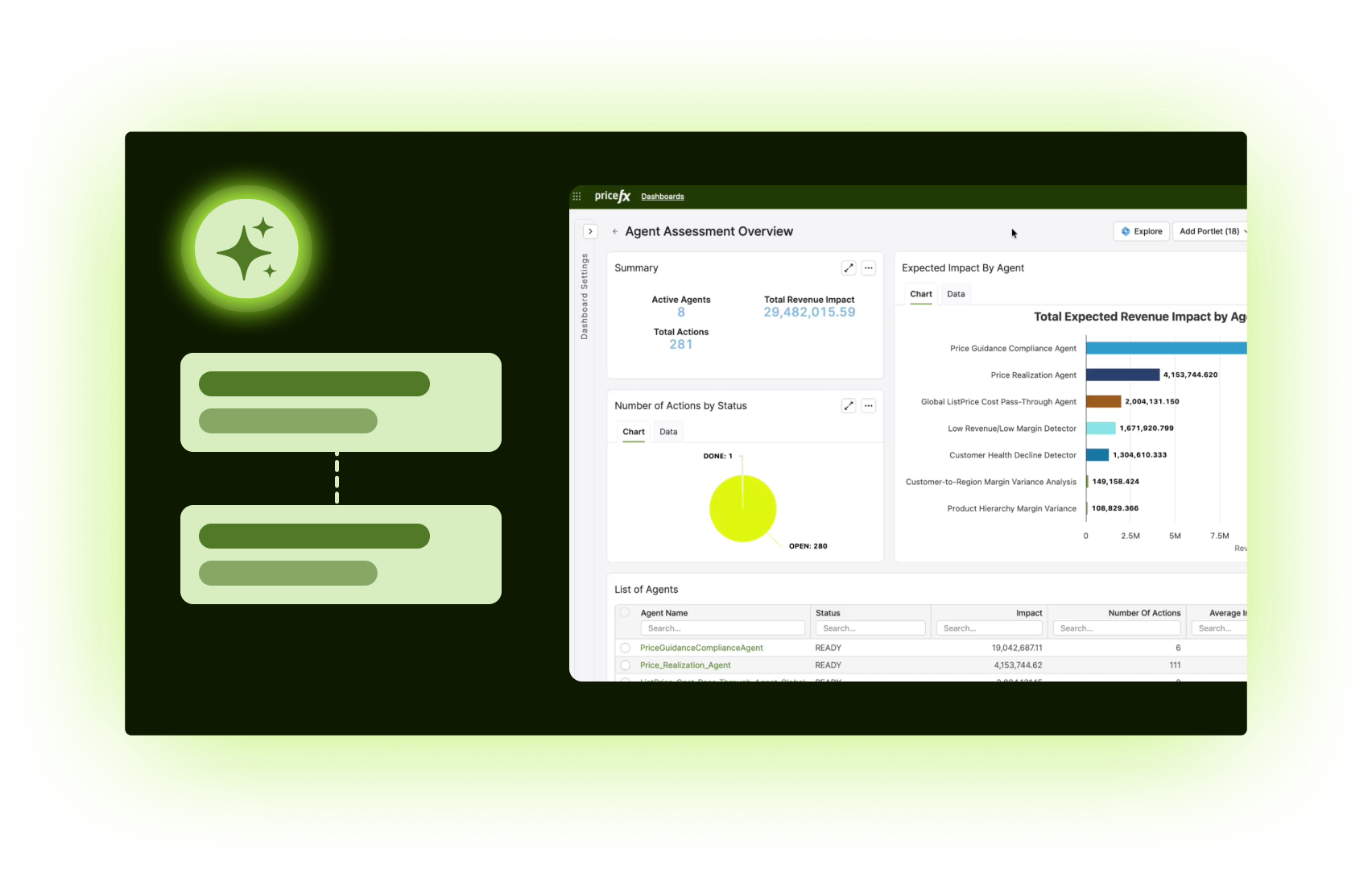
Hands-On lab: build and use Pricefx Agents that detect margin risk and recommend actions
Session speakers:
-
Meredith Campbell, Solution Strategist, Pricefx
-
Dr. Jan Wieneke, Industry Advisor, Pricefx
What happened: Attendees built working pricing agents in a sandbox and put them straight to use. They watched an agent flag margin risk, then acted on its recommendations with guidance that kept them in control. Much of the conversation turned on trust: how to validate what an agent produces. The practical answer was to review the first 10 or 20 results and spot-check against a manual calculation, building confidence from there. Attendees also saw they can tailor agents to their own business by adding definitions directly in the agent plan. The session closed on where to start and who benefits. A strong first agent is below-average price, scanning customer segments, quantities, and compliance to surface the “sweetheart deals” that need action. The teams that gain the span commercial, sales, leadership, finance, and procurement.
In 3 months if I'm doing agents well... I'll be spending less time analyzing and more time making decisions... I won't be spending all my time massaging the data.
- Attendee
Hands-On lab: connect an AI assistant and run pricing in plain language
Session speakers:
-
Sean Missingham, Principal Product Advisor, Pricefx
-
Suzi Rodriguez, Director of Solution Strategy, Pricefx
-
Suzanne Valentine, Senior Director of Pricing AI, Pricefx
-
Garth Hoff, Senior Director, Product Marketing & Industry Strategy
What happened: Attendees got their own AI assistant connected to live Pricefx and were set loose in a real environment. They built and edited quotes, updated price grids, and walked through approvals. They also generated decks and documents that explained pricing decisions to customers and executives. Optimization drew the most energy. Teams ran models, adjusted inputs, and compared several iterations at once instead of deciding one change at a time. Sean Missingham opened with a primer on working with AI assistants that several attendees called the highlight. The session stayed hands-on and candid, with an open invitation to try to break things, and straight answers to the security and data access questions on everyone’s mind.
The best part was telling them to break it. One person did, a little, and that is exactly how we get better.
- Suzi Rodriguez, Director Solution Strategy, Pricefx
Pricing Leaders Symposium
Session speakers:
-
Ronak Sheth, CEO, Pricefx
-
Jennifer Shaw, American Success Leader, Pricefx
What happened: Pricing leaders traded candid views on where AI is working and what it takes to capture the value. The throughline was trust: leaders want recommendations they can explain, approve, and audit before acting on them. A few themes recurred. AI pays off only when systems and data are connected, so decisions can run end to end. Adoption is as much about people and culture as it is about technology. And the work should start from a clear business case, not the technology itself. The discussion got specific on where value leaks and how to prioritize it, with one leader noting that agents are now surfacing more opportunity than teams can act on. Pricing also came up as the natural way into AI for the wider business, alongside a reminder that sales holds the deal context worth bringing in rather than working around.
I can’t believe I’m saying this, but we would be vendor first [rather than build] because we can build what we want because it’s so flexible. I don’t think I would feel that way if it was Vendavo or PROS.
- Anonymized

Behind the scenes
The moments between the sessions



Pricefx is the AI-powered pricing platform companies around the world trust to price smarter and protect margins. Founded in 2011 and built cloud-native from day one, Pricefx serves customers across manufacturing, distribution, chemicals, and beyond, helping them manage, optimize, and quote prices with speed and precision.